


Author
Jiselle Cardenas
Search has officially evolved.
Ranking on page one of Google is no longer the finish line. Today, the real prize is being cited, summarized, and recommended by AI engines, from Google’s AI Overviews to ChatGPT, Perplexity, and beyond.
With the rise of AI chatbots for answers and task assistance, Generative Engine Optimization (GEO) has emerged as a new model for search visibility. GEO is the practice of structuring and refining content to be easily found, understood, and cited by AI-powered search engines (like Google's AI Overviews, ChatGPT, Perplexity) to appear in their synthesized, conversational answers, moving beyond traditional SEO's focus on keyword rankings to ensure content is referenced as a credible source. It involves making information machine-readable, factually sound, authoritative, and clearly answering user intent, so that large language models (LLMs) can incorporate it into comprehensive responses, thereby building brand authority in the new AI search landscape.
This is not a single tactic or content tweak. It’s a comprehensive ecosystem strategy that examines your entire digital footprint. AI engines don’t just scan your website for keywords. It evaluates your credibility, consistency, authority, and reputation across all online platforms.
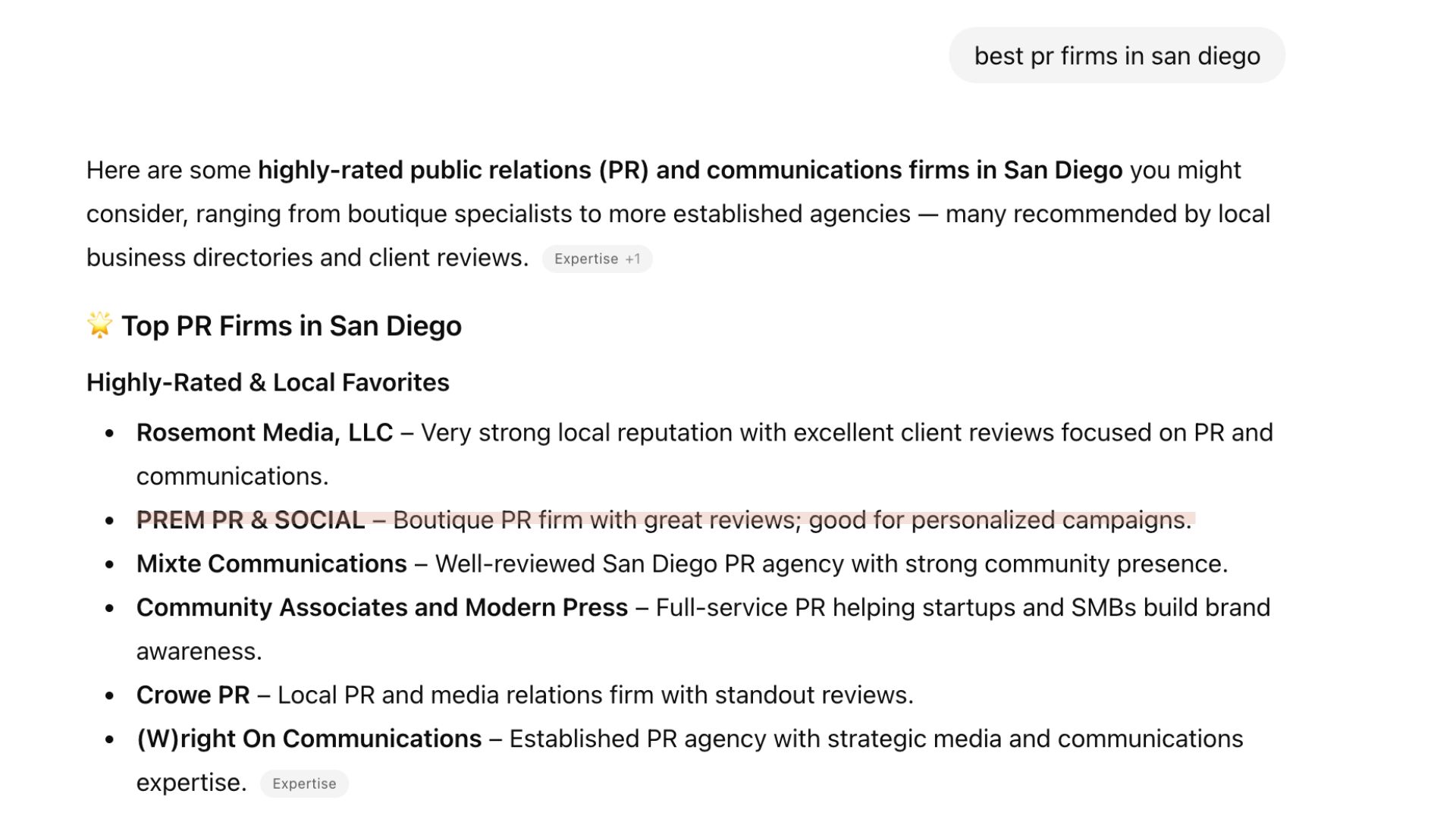
GEO is already impacting PR, SEO, blogs, directories, reviews, and Q&A platforms for users who resort to AI platforms for search results. In this blog, we’ll explain how all of it works together to determine whether AI trusts you enough to include you in its answers. We know what we’re talking about. Take a look at this screenshot from ChatGPT on “Best PR firms in San Diego.”
GEO Is About Trust, Not Just Traffic
The difference between traditional search engine optimization (SEO) and GEO is:
Traditional SEO asked: Can we rank?
GEO asks: Can we be trusted as a source?
AI engines evaluate:
- Who is talking about you
- Where you’re mentioned
- How consistently does your information appear
- Whether real people vouch for your expertise through positive reviews on Google, Yelp, etc.
- How clearly does your content explain concepts about your niche or business
The stronger your digital ecosystem, the more likely AI engines are to pull from your content instead of your competitors’.
What can your business do to start appearing in GEO searches?
PR & Media Mentions: Credibility at Scale
Public relations has quietly become one of the most powerful GEO levers.
AI engines heavily favor:
- Local news outlets
- Industry publications
- Expert interviews
- Press releases
- Quoted commentary
PR matters for GEO search results because PR functions as a third-party validation signal. When reputable outlets talk about you, AI engines assume you’re legitimate, relevant, and trustworthy.
This is especially powerful because PR content isn’t self-published; it’s earned.
PR fuels GEO through media mentions that validate expertise. Third-party coverage boosts authority, and local news outlets strengthen geographic relevance based on the searcher’s location. Interviews and quotes can also position you as a subject-matter expert.
PR is no longer just brand awareness. It’s machine-readable credibility.
So what can businesses do to leverage PR for GEO?
Businesses should take a proactive approach to earn and maximize media mentions that AI engines recognize as credible signals. Start by identifying local, regional, and industry-specific outlets that cover topics related to your expertise or services. Pitch timely stories, expert commentary, or unique data insights to journalists, editors, and bloggers, making it easy for them to reference your business accurately. For example, as a marketing agency like PREM PR & Social, it would be timely to pitch a story on GEO.
It’s also important to submit press releases through reputable newswire services to increase reach and the chance of syndication. Collaborate with high-authority websites, influencers, and industry blogs to create content that naturally cites or links to your business. These mentions act as backlinks and third-party validation, signaling to AI that your brand is authoritative, trustworthy, and relevant. Time your pitches around news cycles, seasonal trends, product launches, or original research to maximize pickup and visibility. Consistent, strategic PR builds machine-readable credibility that directly fuels GEO performance.
SEO & Website Content: Training Data for AI
SEO still matters, but the objective has shifted. Your website goal should no longer be to just try to rank higher than competitors. It should now be acting as training data for AI engines.
For AI to understand and trust your content, it must:
- Answer questions clearly and early
- Use structured formatting (H2s, bullets, tables)
- Be factual, accurate, and authoritative
- Include definitions, examples, and context
- Be easy to extract meaning from
High-Impact GEO Content Types Include
- “What is…” definitions
- Step-by-step guides
- Comparison tables
- FAQ sections
- Glossaries
- Case studies
- Data-backed insights
The clearer your content, the more likely AI engines are to cite it directly in answers.
So what can you do as a business?
Businesses should intentionally shift their content strategy to support both human readers and AI engines. Start by auditing existing website content to identify gaps in clarity, structure, and authority, then update pages to directly answer high-intent questions using clean headings, concise explanations, and scannable formats. Invest in authoritative content that promotes original insights, data, case studies, and expert perspectives related to your business niche that AI systems can confidently reference.
Build clear topical ownership by creating content clusters, such as definitions, FAQs, guides, and comparisons, around your core services, and ensure all information is accurate, current, and consistently reinforced across your digital footprint. In short, treat your website as a source of truth: when AI engines look for answers, your brand should be the one they learn from and cite.
Blogs: The Backbone of GEO
Blogs are no longer optional. They are now one of the most powerful GEO assets you own.
AI loves blogs to pull answers from long-form explanations, the semantic depth, their clear structure, the FAQs and subtopics, expert commentary, and educational tone.
A well-written blog becomes a primary source for AI responses.
GEO-Friendly Blogs Need to Include:
- A strong introduction that answers the main question immediately
- Coverage of related concepts and supporting ideas
- Clean, logical structure
- Internal linking to related content
- Visuals (charts, images, infographics)
- Author bios that establish real expertise
Your blog will still help with SEO, but your strategy should now shift to be written for AI comprehension.
What can you do?
Businesses should commit to a consistent, intentional blogging strategy built specifically for GEO. We recommend publishing 2–4 high-quality blogs per month, each 1,000–1,500 words, focused on answering real customer questions and clearly explaining key concepts within your industry. Every blog should live permanently on your website (not just on third-party platforms), be backlinked to related service and educational pages, and include clear headings, FAQs, visuals, and expert attribution.
Once published, distribute each blog across social media, email newsletters, and other owned channels, always linking back to the original post on your website to reinforce authority and signal source credibility. Over time, this creates a library of authoritative content that AI engines can reliably learn from, reference, and cite, turning your blog into a long-term visibility and trust asset, not just a web traffic strategy.
BBB, Directories & Local Listings: Verification Signals
AI engines use business listings to verify legitimacy, location, services, and reputation.
Making sure your business is up-to-date and on business platforms is crucial for GEO. AI cross-checks your information across the Better Business Bureau (BBB), Google Business Profile, Yelp, industry directories, and local Chamber of Commerce listings.
If your name, address, or services are inconsistent, AI may hesitate to trust or cite you as a top search result, or even a result. A complete, accurate, and consistent BBB profile sends a strong signal that your business is real, established, and reliable.
So what can businesses do to strengthen their GEO?
Businesses should audit, claim, and actively manage every major business listing where AI engines verify credibility. This includes claiming and fully completing profiles on the Better Business Bureau (BBB), Google Business Profile, Yelp, industry-specific directories, and local Chamber of Commerce sites. Ensure your business name, address, phone number, website, services, and descriptions are 100% consistent across all platforms. If you ever move locations or change business names, you always need to make sure this information is updated across these platforms.
Regularly update listings with accurate service details, photos, and business updates so AI systems can confidently cross-check and validate your brand. The more consistent and verified your digital footprint is, the more likely AI engines are to recognize, trust, and surface your business in generative search results.
Review Sites: Reputation Is Now Search Currency
AI engines don’t just read reviews; they analyze them, looking at review volume, review recency, overall sentiment, and consistency across platforms.
Reviews influence GEO in different ways. Positive reviews increase AI recommendations, and negative sentiment can reduce visibility. High volume signals of positive reviews build trust and popularity. Recent reviews show relevance and activity.
Your online reputation is no longer just for real-life customers. It directly impacts whether AI includes you in answers.
The easiest thing you can start doing is asking your customers for reviews!
Businesses should implement a proactive, ongoing review strategy across all major review platforms where AI evaluates reputation, including Google, Yelp, BBB, industry-specific sites, and relevant marketplaces. Actively ask satisfied customers for reviews immediately after a successful engagement, and guide them (without scripting) to naturally mention specific services, outcomes, and location-based keywords relevant to your business.
For example, a review like “PREM is the best social media firm in San Diego” reinforces both expertise and geographic relevance for AI systems. Monitor reviews regularly, respond professionally to both positive and negative feedback, and prioritize consistency and recency. Reviews are no longer just social proof, but structured reputation data that AI engines use to decide whether to recommend, cite, or surface your brand in generative search results.
Q&A Platforms: Reddit, Quora, and Community Authority
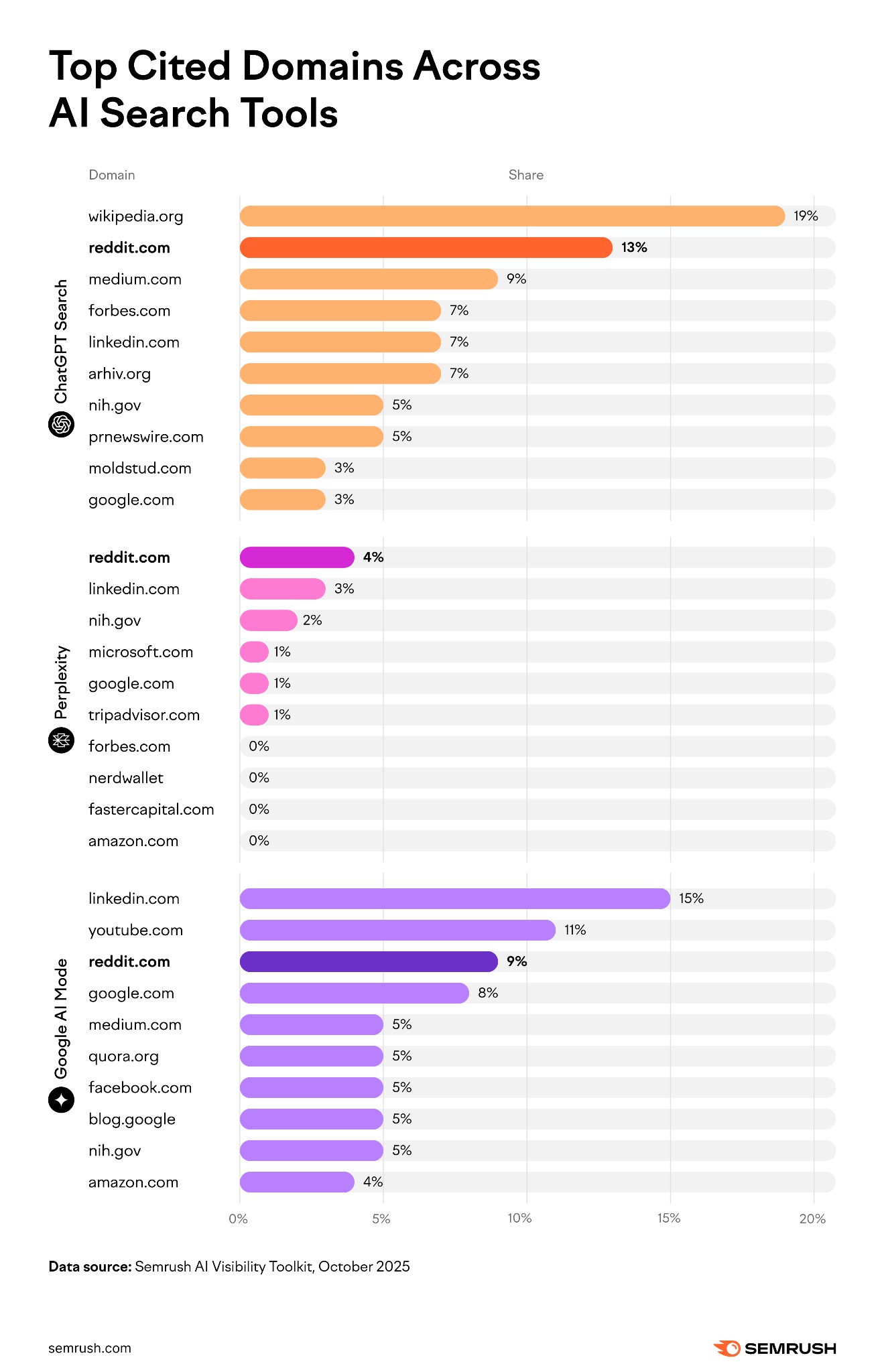
Social platforms, specifically Reddit, Quora, and StackExchange discussions, are GEO gold that AI engines frequently cite because of the natural language, real-world experiences, detailed explanations, and community validation.
You can leverage Q&A platforms for GEO by participating in relevant threads, providing helpful, expert answers, sharing insights without selling, and building a presence in niche communities
Over time, this positions your brand as a recognized voice in AI-generated responses.
For example, start a conversation or contribute to help people find your brand or clear up any questions. Businesses should consistently engage on platforms like Reddit and Quora by starting conversations and answering relevant questions with clear, helpful, experience-based insights. Focus on educating, not selling, by using natural language, real examples, and practical advice. Over time, this activity builds credibility and positions your brand as a trusted voice that AI engines are more likely to reference and cite.
Wikipedia, Medium & High-Authority Knowledge Hubs
Some platforms carry outsized influence in AI search.
Being referenced on Wikipedia, Medium, local media, and industry blogs dramatically increases your GEO footprint.
These platforms matter because AI recognizes them as highly structured, fact-driven, trusted sources, and easy for AI to parse and cite. Even indirect mentions can significantly boost perceived authority.
Businesses should actively seek ways to get mentioned or contribute on these high-authority platforms. Start by creating or updating Wikipedia pages where appropriate, ensuring all content is factual, neutral, and well-cited from credible sources. Contribute thought leadership articles to Medium, industry blogs, and local media outlets, focusing on original insights, case studies, and data-backed commentary.
Regularly monitor mentions across sites and correct any inconsistencies in facts or branding. The goal is to establish your brand as a trusted, citable source, so when AI engines look for authoritative information, your content is easy to find, parse, and reference.
Key Strategies for Winning at GEO
1. Structure Content for AI
- Clear headings
- Direct answers
- FAQs
- Tables
- Definitions
- Step-by-step sections
2. Build Authority Everywhere
- PR and media coverage
- Reviews and reputation management
- Backlinks and citations
- Thought leadership
- Community engagement
3. Optimize for Semantics, Not Keywords
AI understands concepts, relationships, and context, not just phrases.
4. Maintain Strong Technical Website SEO
- Fast load times
- Mobile-friendly design
- Schema markup
- Clean site architecture
5. Use Multimodal Content On Your Website
Images, charts, videos, and data help AI interpret and validate your content more deeply.
The Future of Search Is Conversational, And GEO Is the Playbook
GEO isn’t replacing SEO. It’s expanding it. GEO is the evolution of SEO in an AI-first world.
Brands that adapt now will dominate AI-driven search experiences for years to come. If you want your business to show up in AI answers, you need:
- Strong PR
- High-quality reviews
- Well-structured blogs
- Active participation in Q&A platforms
- Verified listings
- Clear, authoritative content
All of these combined elements are crucial to the new ecosystem of visibility. Being cited in AI answers is the new top ranking.
If you have any questions about GEO or are ready to incorporate GEO into your business strategy, set up a discovery call with PREM PR & Social today.